

If you’ve been exploring confinement food — the traditional foods eaten during zuo yue zi, the Chinese practice of sitting the month — you’ve probably noticed that the same handful of ingredients appear again and again. In my herbal chicken soup, in my mom’s longan red date tea, steamed cod with goji berry, and throughout my herbs for postpartum recovery series: astragalus, red dates, goji berries, dried longan, ginger.
This is not coincidence. These ingredients are the backbone of the Chinese postpartum kitchen because they work gently and consistently — supporting blood replenishment, immune function, digestion, and warmth across weeks of recovery. Once you have them stocked, you can make almost any confinement food recipe with ingredients already in your pantry.
This post is a practical sourcing guide: what each ingredient is, why it matters, what to look for when you’re buying it, and where to find it in the U.S. — including online delivery options if you don’t have an Asian market nearby.
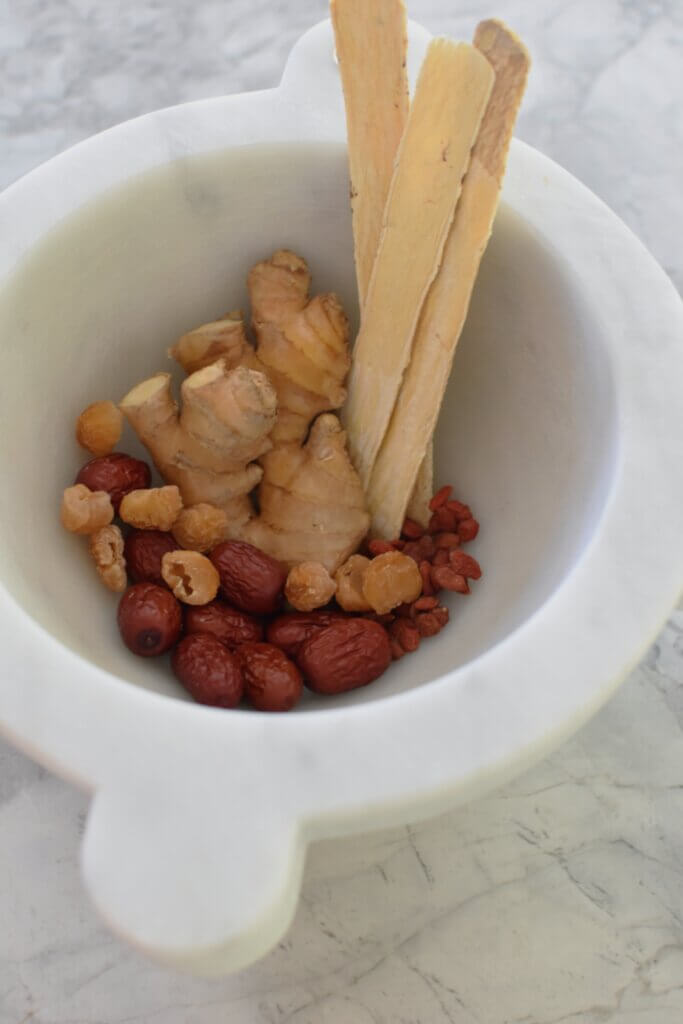
The Core Pantry Ingredients
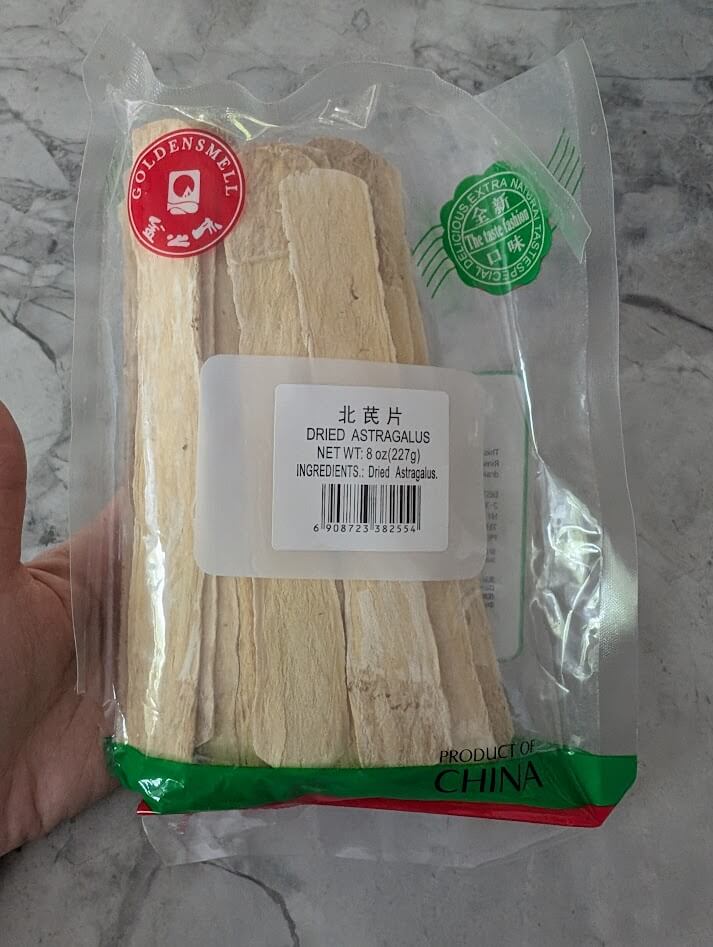
Astragalus Root (黄芪 — Huáng Qí)
Astragalus root is one of the most important herbs in traditional Chinese medicine for postpartum recovery. It is used to tonify Qi — the body’s vital energy — and is considered essential for rebuilding strength and stamina after birth. It is also one of the most studied herbs in the Chinese pharmacopeia for its effects on the immune system.
In my herbal chicken soup recipe, I use about 10 grams of astragalus slices per pot — enough to contribute meaningfully to the broth without overpowering the flavor. It has almost no taste on its own; it simmers quietly in the background.
Note from the research: The National Center for Complementary and Integrative Health (NCCIH) notes that astragalus has a long history of use in traditional Chinese medicine and is being studied for its potential effects on the immune system. Preclinical research suggests astragalus may support milk production, and it has a long history of use as a galactagogue in traditional Chinese medicine (Liu et al., 2015).
What to buy: Look for astragalus in flat, pale-yellow strips or slices — not powder. It’s sold in Chinese herbal medicine shops and Asian grocery stores, often labeled 北黄芪 (Běi Huáng Qí). You can also order it online through Weee (see sourcing section below).
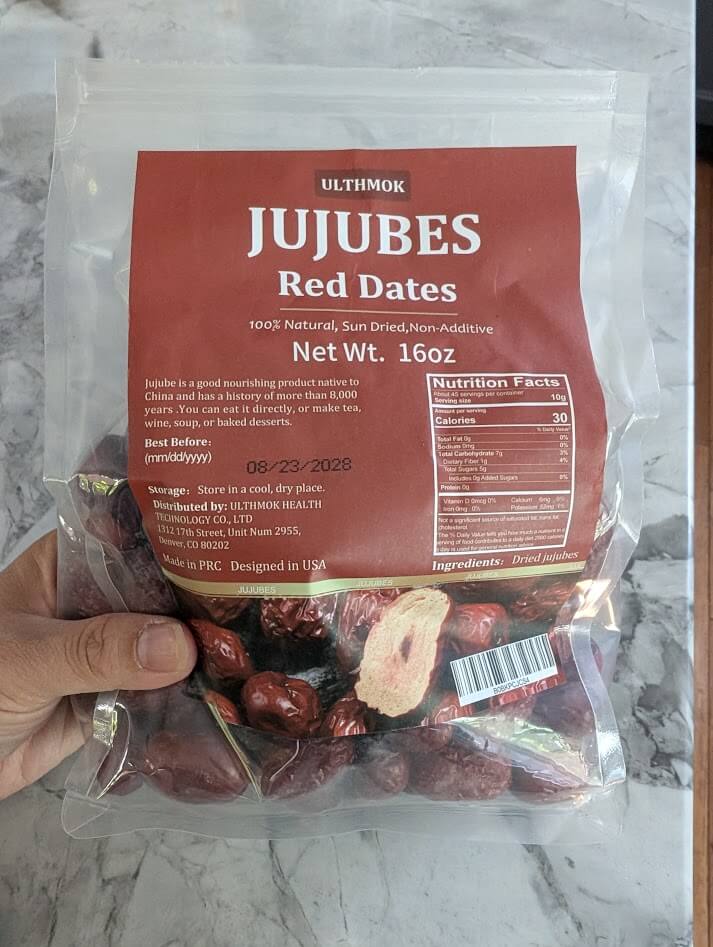
Red Dates / Jujube (红枣 — Hóng Zǎo)
Red dates are perhaps the single most foundational ingredient in Chinese postpartum cooking. They appear in soups, teas, congee, and desserts — wherever there is a woman recovering from birth, there are red dates. In TCM, they are prescribed to nourish blood, strengthen the spleen, and calm the spirit.
From a nutritional standpoint, red dates are a meaningful source of Vitamin C, which plays a critical role in iron absorption — especially important postpartum when iron stores are depleted. About three red dates provide 77% of the daily recommended value of Vitamin C (Tan, 2025). They’re also rich in potassium and antioxidants.
You’ll find red dates in both my herbal chicken soup and longan red date tea recipes. The technique that makes a difference: cut slits into the sides before cooking, or halve them entirely. This opens the fruit and lets the flavor and nutrients fully release into the broth or tea.
What to buy: Look for whole dried red dates with deep, reddish-brown skin. They should be plump and not shriveled. Red dates are one of the most widely available Chinese pantry staples — you can find them at nearly any Asian grocery store, and increasingly at mainstream stores like Wegmans and Whole Foods, or even online from Amazon.
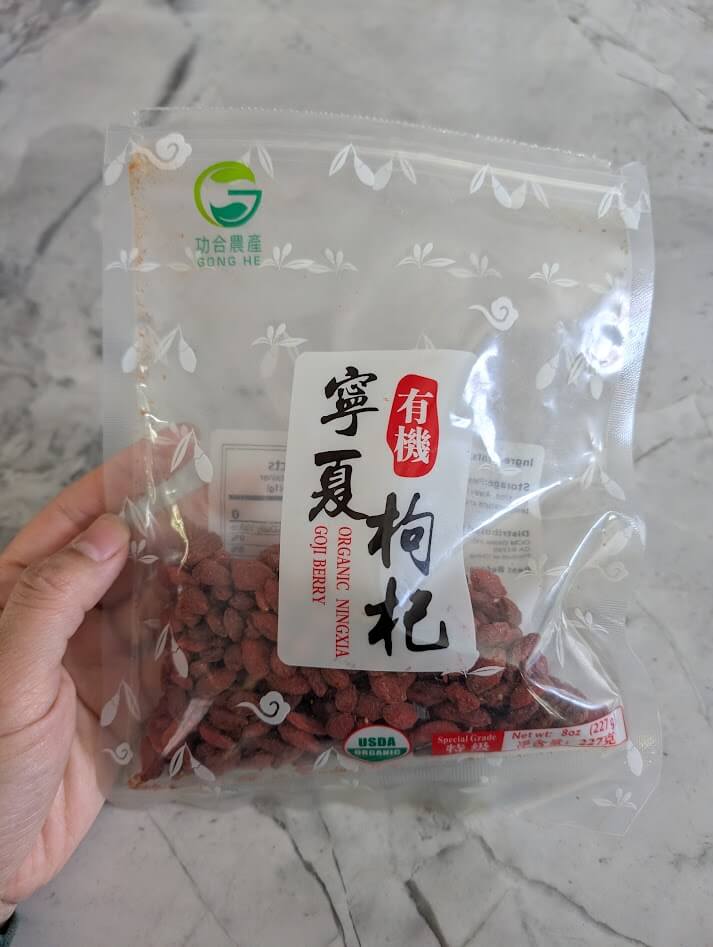
Goji Berries (枸杞 — Gǒu Qǐ)
Goji berries are a gentle, versatile ingredient that add color, mild tartness, and nutritional value to soups, teas, and congee. In TCM, they are used to nourish Liver and Kidney Yin and replenish Jing — vital essence — making them a natural fit for postpartum recovery formulas.
Nutritionally, goji berries are rich in antioxidants, Vitamin C, and iron (Vidović et al., 2022).
One practical note: add goji berries in the last 5 minutes of cooking (or even right before serving). Their bright red color fades quickly with heat, and they become mushy if simmered too long. They’re best used as a finishing ingredient. They’re also great for snacking!
What to buy: Like red dates, goji berries are easy to find. Most Asian supermarkets carry them in the dried goods aisle. Wegmans and many other mainstream supermarkets have started carrying them as well. When buying online, look for plump, bright red berries without excess moisture.
Dried Longan (龙眼 / 桂圆 — Lóng Yǎn / Guì Yuán)
If you’ve read my longan red date tea post, you already know how much I love dried longan. It’s intensely sweet, chewy, and — honestly — addictive as a snack. In TCM, it’s prescribed to invigorate Qi, calm the spirit, and activate blood: a combination that speaks directly to the exhaustion and emotional vulnerability of the postpartum period.
Dried longan is the backbone of the longan red date tea, but it also works beautifully added to pork rib soup, black sesame dessert soups, and red bean soup. It’s one of those ingredients that elevates a simple broth into something unmistakably Chinese postpartum.
What to buy: Look for dried longan in the dried goods aisle of Chinese grocery stores, often sold in clear bags. It may be labeled as 桂圆 (Guì Yuán) rather than longan. Seedless varieties are more convenient. It’s available on Weee (see below).

Motherwort (益母草 — Yì Mǔ Cǎo)
Motherwort is the herb whose Chinese name literally means “herb beneficial to mothers.” It is used in the early postpartum period to support uterine contraction, encourage the clearing of lochia, and provide a mild calming effect. My mom covers motherwort in depth in the herbs for postpartum recovery post — I’d recommend reading that for full context on timing and use, since this is one ingredient where the practical guidance matters most.
For sourcing purposes: motherwort is available in granule form (dissolves in hot water) and dried herb form. It is intensely bitter; my mom always recommends brewing it with a few red dates or a small spoonful of brown sugar to make it palatable.
Chinese Yam (山药 — Shān Yào)
Chinese yam — shān yào — occupies the space between food and medicine so naturally that it’s a perfect embodiment of the Chinese concept yào shí tóng yuán: food and medicine from the same source. (My mom writes beautifully about this in the herbs for postpartum recovery post).
It supports digestion, helps the body absorb nutrients, and in TCM is said to tonify the spleen and stomach — the organs considered central to postpartum recovery. It is particularly appropriate in the first week postpartum, when meals should be easy to digest: steamed yam, or a simple yam and red date congee.
A note on identification: Chinese yam (Dioscorea opposita, also called Dioscorea polystachya) is sold fresh in Chinese grocery stores — it’s a long, hairy, light-brown tuber with a sticky, mucilaginous texture when cut. It may also be sold as Japanese nagaimo, which is botanically the same plant or a very closely related variety. When dried (for use in soups and broths), it’s sold as white, flat slices and labeled 淮山 (Huái Shān) or 山药片 (Shān Yào Piàn). Fresh Chinese yam / nagaimo is sometimes available on Weee, depending on the season — it’s worth checking.
Note from the research: Studies have found that Chinese yam (Dioscorea opposita) contains prebiotic fiber that supports the gut microbiome, as well as compounds with anti-inflammatory properties. Postpartum gut health affects everything from nutrient absorption to mood (Cui et al., 2023).
Ginger (生姜 — Shēng Jiāng)
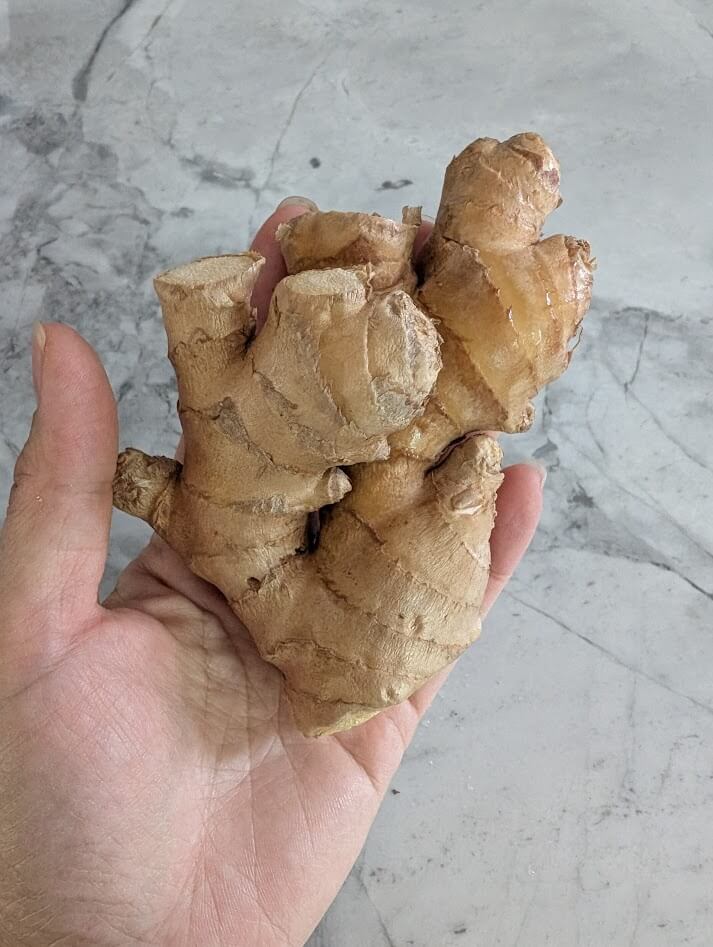
Fresh ginger is in virtually every confinement food recipe — soups, teas, stir-fries, and foot baths alike. In TCM, it warms the middle, promotes circulation, and helps dispel cold from the postpartum body. Clinically, it is a well-studied vasodilator with anti-inflammatory and anti-nausea properties.
One practical note from the traditional approach (and one I mention in both my soup and tea recipes): in the first few weeks postpartum, use ginger sparingly — a few slices is plenty. Excessive ginger early on can cause internal “heat” or constipation. As the body stabilizes, you can be more generous.
Fresh ginger is available everywhere and needs no special sourcing guidance — just keep a knob in your produce drawer.
A Quick Formula to Use These Together
When making any pork rib or chicken broth, try this simple baseline: 10g astragalus, 3 red dates (slitted), and a thumb-sized piece of ginger in cold water. Bring to a boil, then simmer for at least an hour. Add goji berries in the last 5 minutes. This is the foundation of confinement food cooking — and once it’s in your muscle memory, you can build infinitely from there.
For a full soup recipe, see herbal chicken soup. For a tea, see longan red date tea.
Where to Buy: A Note on Sourcing
Finding these ingredients in the U.S. is easier than it used to be. Here’s the short version:
Red dates and goji berries are the most widely available — you can find them at nearly any Asian grocery store, and increasingly at mainstream stores like Wegmans and Whole Foods.
Astragalus and dried longan are best found at a Chinese or Asian grocery store in the dried goods or herbal medicine aisle. If you don’t have one nearby, both are available online.
Motherwort is more specialized — Chinese herbal medicine shops are your best bet, though it’s also available online.
Chinese yam (fresh) is available at Chinese grocery stores, sometimes labeled nagaimo. Dried slices are more shelf-stable and sold at Chinese markets.
Sourcing Online: Weee
For anyone who doesn’t have an Asian grocery store nearby — or who just wants fresh, quality ingredients delivered to the door — Weee is my personal go-to. I’ve been using Weee for years to get fresh Asian produce and pantry staples delivered to my house. They deliver to all 50 U.S. states, and orders above $35 qualify for free delivery.
Beyond the postpartum pantry staples, Weee carries fresh Asian produce, Asian bakery goods, snacks, and interesting fruits that are hard to find elsewhere. If you’ve never explored nagaimo or fresh Asian pears, it’s worth browsing.
Here are the specific products I use and recommend:
| Ingredient | Chinese Name | Weee Link |
|---|---|---|
| Astragalus Root Slices | 黄芪 (Huáng Qí) | Premium Radix Astragalus Slices |
| Dried Longan | 桂圆 (Guì Yuán) | Fancy Grade Dried Seedless Longan |
| Red Dates | 红枣 (Hóng Zǎo) | Premium Top Grade Red Dates |
| Goji Berries | 枸杞 (Gǒu Qǐ) | Ningxia Premium Goji Berries |
| Motherwort | 益母草 (Yì Mǔ Cǎo) | Motherwort Tea |
Note: Chinese yam (nagaimo / 山药) availability on Weee varies by season — check the fresh produce section.
Putting It All Together
If you’re preparing for postpartum recovery during your third trimester, stocking this pantry in advance is one of the most practical things you can do. Most of these ingredients are dried and shelf-stable — you can buy them weeks ahead of time. I also have a tip in my longan red date tea recipe for pre-assembling “tea kits” (measured dry ingredients in Ziplock bags) so that anyone helping you during recovery just has to open a bag and add water.
Small preparation now means warm, nourishing meals are within reach when you’re exhausted and running on three hours of sleep.
This post is for informational purposes only and does not constitute medical advice. Always consult your healthcare provider before beginning any herbal regimen, especially while breastfeeding.
References
Cui, Y., Zhou, Y., Li, Y., Wang, J., Li, D., & Chen, F. (2023). Chinese yam and its active components regulate the structure of gut microbiota and indole-like metabolites in anaerobic fermentation in vitro. Nutrients, 15(24), Article 5112. https://doi.org/10.3390/nu15245112
Liu, H., Hua, Y., Luo, H., Shen, Z., Tao, X., & Zhu, X. (2015). An herbal galactagogue mixture increases milk production and aquaporin protein expression in the mammary glands of lactating rats. Evidence-Based Complementary and Alternative Medicine, Article 760585. https://doi.org/10.1155/2015/760585
National Center for Complementary and Integrative Health. (2025). Astragalus. National Institutes of Health. https://www.nccih.nih.gov/health/astragalus
Tan, S. (2025, October 27). Chinese jujube fruit: Is it healthy? WebMD. https://www.webmd.com/diet/are-there-health-benefits-of-jujube-fruit
Vidović, B. B., Milinčić, D. D., Marčetić, M. D., Djuriš, J. D., Ilić, T. D., Kostić, A. Ž., & Pešić, M. B. (2022). Health benefits and applications of goji berries in functional food products development: A review. Antioxidants, 11(2), 248. https://doi.org/10.3390/antiox11020248


7 Comments