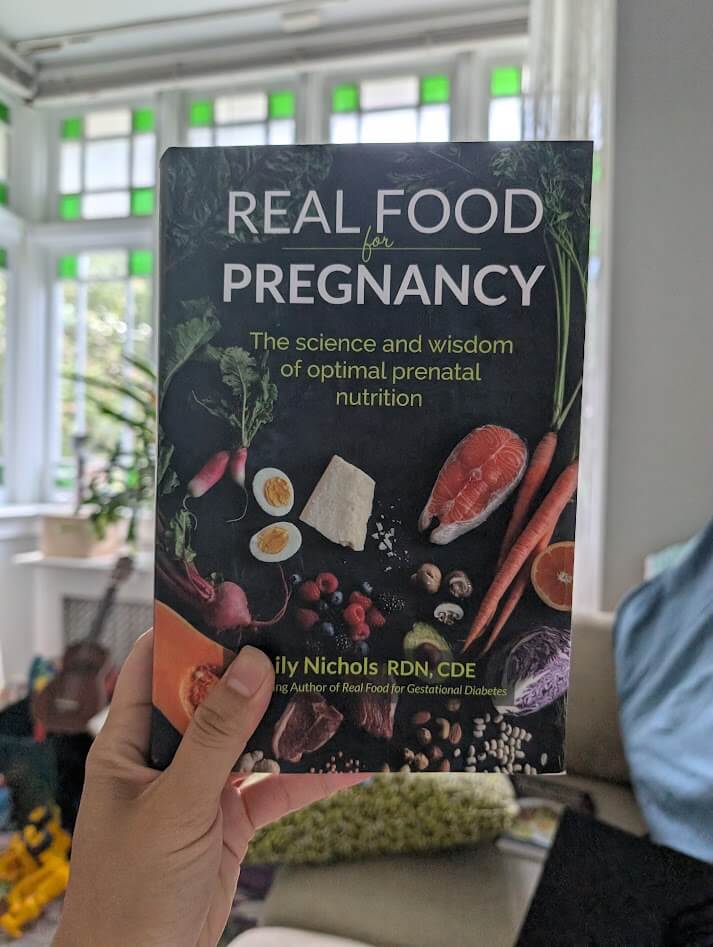
Real Food for Pregnancy by Lily Nichols is one of the most recommended prenatal nutrition books out there, and I picked it up expecting to find a lot of common ground. In some ways I did. Nichols and I both believe that pregnancy and postpartum nutrition should be rooted in real food and in the wisdom of how people have fed new moms for generations. That’s the premise of everything I write here. However, I have some big concerns after reading this book and fact checking its claims. Here’s my review of Real Food for Pregnancy, structured around questions people might have about the material.
First, what I like about it
It is thoroughly referenced. Nichols has a citation for everything, which makes her claims really easy to fact check.
The nutrient-level detail is exceptional. She diligently details what each nutrient does, why pregnancy raises the requirement, and which whole foods supply it in meaningful amounts. Choline and eggs. Glycine and long-simmered broth, which was a pleasure to see treated seriously rather than as a wellness trend, given that it’s a cornerstone of Chinese postpartum tradition. The book is ahead of its time in recommending full fat dairy, which the Dietary Guidelines for Americans finally agrees with in their 2025-2030 version.
She teaches carbohydrate quality. The book explains what glycemic index means and why it matters, what happens to your blood sugar when you eat something, and how you pair carbohydrate foods with protein foods. This is great information.
The chapters on common complaints and the fourth trimester are helpful. The guidance on nausea, heartburn, and constipation is practical and compassionate. I was nodding along reading the postpartum material, which aligns with my own posts on sitting the month and global postpartum traditions.
This book has a lot of useful information in it, with some real issues. Let me answer some common reader questions from my point of view as a dietitian and public health researcher, compared to how Nichols answers those same questions, and explain why her answers are problematic.
1. Should I follow a low carb pregnancy diet?
Carbohydrates are essential for fetal development. Carbohydrates should account for about half of a pregnant woman’s energy intake in order to meet the brain glucose needs of mom and baby.
Real Food for Pregnancy prescribes a lower-carbohydrate diet for pregnant women generally — not just for women managing gestational diabetes, where the case is stronger and where Nichols has done real work, but as the default for pregnant women. She says to
Replace your typical serving of grains with a serving of vegetables and/or a larger portion of meat or fish
arguing for 90–150 g of carbohydrate a day. At a typical pregnancy intake of around 2,200 calories, that’s roughly 16 to 27 percent of energy — below the 33 to 40 percent that has conventionally defined a therapeutic low-carbohydrate diet in pregnancy.
Generalizing a therapeutic approach from a population that needs it to a population that doesn’t is a significant claim, and it needs strong evidence behind it.
The evidence at these very low carbohydrate intakes is thin. A 2021 systematic review looking for a safe lower threshold in pregnancy found no human studies at very low carbohydrate intakes to evaluate. It concluded that “a carbohydrate intake in pregnancy between 47–70% supports normal fetal growth patterns.”
So where do her numbers come from? An ethnographic analysis of 229 hunter-gatherer societies. That paper found carbohydrate intake ranging from 3 to 50 percent of energy depending on environment — with most populations, across most inhabited latitudes, sitting at 30 to 35 percent. Only groups in tundra and northern forest came in at 15 percent or less. She does admit that, but what she doesn’t note is that those arctic people carry fatty acid metabolism genes that almost no one else has.
Also, the paper says nothing about what’s safe and optimal for pregnancy.
My take: You don’t need to count carbs. The quality of the carbohydrate matters more than the quantity in determining health outcomes for mom and baby. To her credit, Nichols spends real time explaining what makes a high quality carbohydrate. That’s the part you should focus on.
2. Is soy safe during pregnancy?
Soy is full of good fats, fiber, vitamins, and minerals. Some soy products like textured vegetable protein and soy protein isolate that’s found in many protein powders and protein bars contain estrogen-like chemicals that could have adverse effects. Kathy McManus, Director of Nutrition at Brigham and Women’s, states that it’s safe eat whole soy foods like soy milk, edamame, and tofu, in moderation, several times a week.
Now this is what Real Food for Pregnancy says about soy:
Despite what you’ve read about soy, it’s not the health food you think it is, and it’s especially problematic at a time when your nutrition matters most: before and during pregnancy.
To understand where this comes from, you have to look at the book’s intellectual foundation. Nichols cites Weston A. Price approvingly and often — a Cleveland dentist who traveled the world in the 1930s documenting the diets of isolated populations and published Nutrition and Physical Degeneration in 1939.
When we want to know how a culture has traditionally fed its pregnant and postpartum women, we have options: scholars from within that culture, ethnographers who speak the language. Reaching instead for a white American dentist’s observations from ninety years ago shapes what you end up able to see.
The Weston A. Price Foundation has held an institutional anti-soy position for decades. It’s one of their signature commitments. So this isn’t an independent examination of soy that happened to arrive at a skeptical conclusion. It’s a position that comes with Price’s biases.
And it contradicts the book’s own thesis.
Soy is not a modern industrial invention that traditional cultures avoided. Tofu and soy milk are foundational across East Asian cuisine, and they appear specifically in pregnancy and postpartum feeding. Fish and tofu soup is a classic postpartum dish, valued because it’s gentle, warming, protein-rich, and easy on a recovering digestive system. Soy has been a part of East Asian diets for 5-7 millennia.
A book whose entire argument is eat the way traditional cultures ate cannot dismiss one of the most important traditional foods on earth. But the contradiction goes unremarked, unsurprising given the framework it inherited.
3. Can slightly high blood sugar give my baby a heart defect?
No — not in the way this book implies. The study behind that claim is real, but the risk is far smaller and far more specific than the sentence suggests.
Risk communication is one of my biggest concern with the book, and I’ll explain that.
Nichols writes:
Researchers at Stanford University have shown that elevated blood sugar (far below diagnostic threshold for gestational diabetes) is linked to a significantly higher risk of congenital heart defects.
She offers this as justification for following her low-carb diet, without providing additional context.
That sentence is frightening. So let’s look at the actual study, a legitimate case-control design published in JAMA. The authors analyzed data on 277 new moms, about half who had babies with congenital heart disease and half without, comparing blood glucose drawn during the second trimester.
The significant finding was that for babies with Tetralogy of Fallot — a rare condition affecting about 1 in 2,000 babies — median second trimester blood glucose was 97.0 mg/dL compared to 91.5 mg/dL in healthy controls. No association was found for the other condition they tested.
That is a real finding, but it is not remotely what “significantly higher risk of congenital heart defects” sounds like when you read it in a book about what to eat while pregnant.
When you tell someone that a behavior increases their risk of a bad outcome, you owe them the baseline. How common is that outcome to begin with? How much does the risk actually change? Without those two numbers, “increased risk” isn’t information — it’s fear with an arbitrary citation attached. The reader supplies the missing magnitude herself, and a frightened pregnant woman supplies a very large number.
I spent over a decade at the National Academy of Sciences translating health research into federal policy, so I know this to be important: improper risk communication changes people’s behavior in unintended ways. It’s something that I caught over and over again reading this book.
4. Is eating chicken liver during pregnancy a good idea?
Liver is a highly nutritious food. Eat it if you like it, in moderation (1-2 ounces, 1-2 times a week) as too much can result in vitamin A toxicity. It’s certainly not a necessity.
In a section encouraging liver consumption, Real Food for Pregnancy states plainly:
Avoidance of liver is a known risk factor for inadequate vitamin A intake.
after musing that
ongoing concerns over vitamin A toxicity from liver consumption are perplexing.
That struck me as odd, since most Americans don’t eat liver. Are we all at risk of inadequate vitamin A intake? I pulled the paper. It draws on a 1992 Dutch national food consumption survey, and indeed, it found that around 70% of women who didn’t eat liver had vitamin A intakes below the RDA.
The issue here is selective interpretation of data. The same paper found that 60% of the women who did eat liver exceeded the safe upper intake limit of 3,000 RE, and 23% exceeded 7,500 RE. Its actual conclusion was that a multivitamin containing up to 1,200 RE produces adequate intake without exceeding the upper limit, and that if liver is consumed, it should be in moderation.
5. Can I have a healthy pregnancy as a vegetarian or vegan?
Yes, you can have a healthy vegetarian or vegan pregnancy with planning and attention to a few key nutrients, mainly B12 and iron.
Nichols provides numerous reasons why a vegetarian diet is inadequate during pregnancy, and states that she
cannot ethically endorse a fully vegan diet during pregnancy.
Here’s what the research shows. A review published in an obstetrics journal looked at 22 studies of vegetarian and vegan pregnancies. None of them found more serious complications or birth defects. Babies were carried to term just as often as in mothers who ate meat. Birth weight was mixed — five studies found slightly smaller babies, two found slightly larger. The one thing that showed up consistently was the risk of running low on two nutrients: vitamin B12 and iron.
It’s not wrong to urge caution here. It is in fact more difficult to meet nutrition goals for pregnancy if you are vegan, but it’s certainly possible, and many women do it. My concern here is the refusal to engage. Telling a woman who is vegan for religious or ethical reasons that she has to start eating meat doesn’t help.
If you are concerned about your vegetarian or vegan diet, ask your OB/GYN for advice. They can review your bloodwork and recommend appropriate supplementation, and refer you to a dietitian if needed.
Real Food for Pregnancy book review rating
★★★
Three stars. As a fellow dietitian, I commend Lily Nichols for creating a thoroughly researched document that provides a lot of good information for a population that is underserved. She obviously put an enormous amount of work into it.
The subtitle of this book is The Science and Wisdom of Optimal Prenatal Nutrition. Let me just say that there is such a thing as over-optimizing. Nutrition is not a system where more optimization is always better. Past a certain point, the marginal benefit of another adjustment (add liver, all organic, no grains) is small, while the cost (anxiety, money, mental load) climbs. A pregnant woman eating a varied diet with a prenatal vitamin is doing well. She is not one serving of liver away from disaster.
So, take what you find to be helpful, and don’t feel bad about disregarding the rest. And if you finish this book feeling like you’re failing your baby — what a lucky baby, truly, to have a mom who cares so much that she read all of this. That feeling is a result of how the information was presented, not a measure of how you’re doing.