

My daughter is 15 months, and my son will be 4 years this summer. I still feel very much in the postpartum trenches, with my youngest still breastfeeding, teething, and keeping me up at night. In this post, I’ll share my thoughts and lessons learned about sleep and breastfeeding, and the difference in my postpartum experience between my first and second baby.
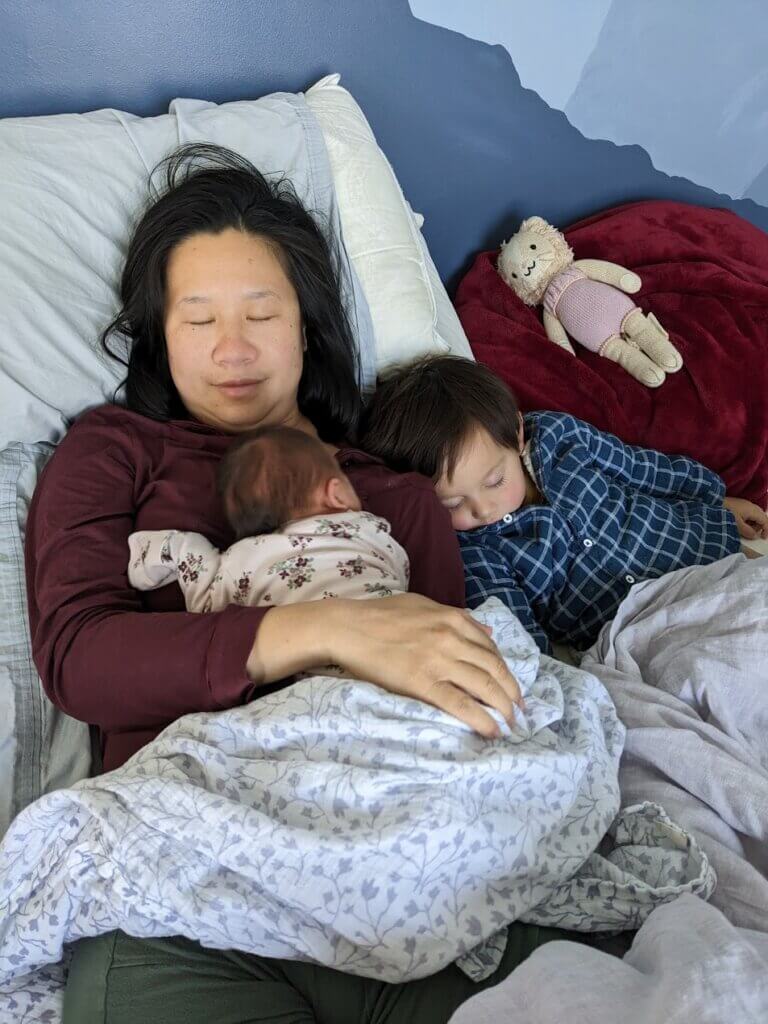
The Postpartum Village
I had an incredible support system. My mom stayed with us for the zuo yue zi period and made me so much nourishing food. My dad and in-laws also stayed for some time, helping with housework and holding the baby at night. We also had friends who brought us meals that I still remember fondly—cabbage rolls, bone broth with beets, salmon soup, homemade bread, tuna casserole. I know a lot of people don’t have this kind of village, which is what drew me to create this website.
From One to Two: Managing Expectations and “Deeply Feeling Kids”
The transition from one to two kids was hard in obvious ways, i.e., trying to rest and recover with a toddler bouncing around. It was also easier in some ways, because my expectations were more realistic. My son is a spirited, intense, persistent, sensitive child—a “deeply feeling kid” (DFK) in Dr. Becky’s terms. He’s a bit more even-tempered now, but even as a newborn, he was highly alert, curious, and had deep FOMO. He would never sleep. I think only parents with DFKs truly understand the struggle and reward of raising a child like this.
The Reality of Sleep Deprivation and Surrendering to the Floor Mattress
My daughter was born a bit more laid back, but as she enters toddlerhood, she’s proving to be just as determined and opinionated as her brother. She slept okay as a baby, but now? She does not sleep. I don’t think I was fully prepared for how little rest I would be getting as a parent. I thought maybe the newborn sleep deprivation would last a few months. Not with my children.
I am still struggling, and believe me, I have tried all the sleep training methods: “cry it out,” the chair method, hiring not one but two sleep coaches. My persistent, sensitive children will cry for hours. I finally just gave up, and I now sleep with my 15-month-old on a firm mattress on the floor and nurse her when she wakes up 11,235,980 times a night. It’s fine! I will myself to cherish the milk-drunk snuggles.
Night Weaning While Bedsharing
I am working on weaning my daughter off night feeds in the gentlest way possible, coined by Elizabeth Pantley, author of The No Cry Sleep Solution, as the Pantley Pull-Off.
Here are the basic mechanics:
- Nurse her until she’s drowsy but not fully asleep — eyes heavy, sucking slowing
- Break the latch with your finger before she’s all the way out
- Hold her jaw closed gently for a few seconds so she doesn’t root back
- If she protests, wait — hold her, shush, pat. Don’t relatch unless she’s fully escalating
- If she escalates, relatch briefly, then try again
This sometimes takes an hour or even longer. When she’s sick or when I’m very sleep-deprived, it’s easier to just let her nurse to sleep. Nothing about sleep with DFKs is easy!
Why We Need to Talk About Safe Bedsharing
I highly recommend looking up safe bedsharing guidelines (like the ones from Cosleepy) before having a baby, even if you don’t think you’re going to do it. I truly believe the American recommendation of “no bedsharing” is the pediatric equivalent of abstinence-only education. According to recent American Academy of Sleep Medicine surveys, roughly half of U.S. parents report sometimes or always co-sleeping with their children. Other data suggests that up to 90% of parents may co-sleep at some point, with over 50% falling asleep in bed with their baby unintentionally. It is so much safer to fall asleep with your baby intentionally on a firm floor mattress with no loose bedding than to do it unintentionally on a sofa or other high-risk surface.
The Breastfeeding Learning Curve and In-Home Support
The other major learning curve of first-time parenthood was breastfeeding. It seems like it should be so natural, but it takes immense practice! I had a home visit from a lactation consultant soon after I arrived home with Kai, and it was a game-changer. She was so much more helpful than the hospital LCs, and having the context of being in my own home was exactly what I needed. (For local DC parents, I used the Breastfeeding Center of Greater Washington).
Most health insurances cover lactation consultants, and an in-home visit might just require a small travel fee. Video visits are also a great option. Luckily, the second time around, I knew what I was doing. It’s still hard those first few weeks when your milk comes in and the engorgement hits, especially with such tiny newborn mouths, but it does get better.
I actually didn’t wean my oldest until a week after my youngest was born, in an attempt to ease his transition into siblinghood. For nearly four years, my body has been producing milk for another person. It’s kind of wild to think about.
Seeing the Light in the Postpartum Tunnel
My daughter is walking and learning new words every day. Just last night, she started saying “onje” for orange, and pointed at a cinnamon mochi ice cream we were eating, demanding, “onje!!” In the mornings after I change her diaper, she picks up her dirty diaper and walks it over to the diaper trash. This morning after she did that, she peed in the potty for the first time! Her big brother is absolutely delighted by her progress. He loves entertaining her, chasing her around and under our legs as she giggles, so proud of making her laugh.
I still feel like I’m in the postpartum tunnel, my heart and brain gnarled and groggy, but looking at the two of them, I am definitely seeing the light.
Have thoughts on Bernice’s reflection? Please leave a comment!
Similar Stories
References
American Academy of Sleep Medicine. (2025, February 25). New data reveals that half of parents co-sleep with their child. https://aasm.org/new-data-reveals-that-half-of-parents-co-sleep-with-their-child/
Belanger, T. (n.d.). Cosleepy. Retrieved March 25, 2026, from https://cosleepy.com/
The Lullaby Trust. (2023, March 13). New survey shows 9 in 10 parents co-sleep but less than half know how to reduce the risk of SIDS. https://www.lullabytrust.org.uk/9-in-10-parents-co-sleep-but-less-than-half-know-how-to-reduce-the-risk-of-sids/





Did your postpartum with Elizabeth feel distinctly different than your PP with Kai? I also wonder how it might differ for moms that start and stop breastfeeding before their 2nd vs. just continuing on from the 1st like you did.
I felt postpartum way more with my first than with my second. With my first, I was *always* thirsty, chugging water and electrolytes like a performance athlete, and *craved* eating cartilage and tendon and turkey wings. Oh and terrible shooting Mommy’s thumb and jelly joints causing all sorts of back and knee and hip pain/weakness. With my 2nd, I still had all the joint weakness but I didn’t have the cravings or thirst with such intensity like I did for my 1st. And then also no Mommy’s thumb in the immediate PP — only getting a little now after being out of practice carrying my baby full-time for 6 months and now she’s older baby (17-18 lbs) weight instead of newborn weight.
Hi Kristine, thanks for sharing about your postpartum experiences! That’s so interesting about having weakness in your joints and craving cartilaginous foods. Your body was telling you what it needed!
I’m not sure I felt physically too different between the two postpartum periods, only that healing with the second was easier because I tore less during the birth. I will say it’s taking my body longer to bounce back to pre-baby fitness with the second. @_@
Continuing breastfeeding with the second before stopping with the first was a crazy experience. The colostrum returned and had to go through the same engorgement process with the milk coming in!