

Editor’s Note: This is Part 2 of a series written by my mom, Ning Wu, sharing her approach to postpartum herbal care. Reviewed by Bernice Chu, MSPH, RD. Read Part 1 here, which covers the dandelion herbal foot bath.
The postpartum herbs used in Chinese tradition are not dramatic. They don’t promise quick fixes. They work slowly, gently, and in partnership with food and rest — which is also why, in my experience, they tend to be safe.
In Chinese medicine, the month after birth is understood as a time of deep depletion. The body has given enormously — blood, energy, essence. The herbs for postpartum recovery I describe here address that depletion in different ways: some help the uterus complete its work, some open the channels for milk, some nourish digestion so the body can absorb what it’s being fed. Together, they form the herbal foundation of zuo yue zi (坐月子) — “sitting the month.”
I will cover four postpartum herbs here: motherwort, lù lù tōng, wáng bù liú xíng, and Chinese yam. I’ll also share the four everyday pantry herbs I consider essential for any new mother’s kitchen.
A note before we begin: every person’s body is different. What works beautifully for one new mother may not suit another. If you have a chronic health condition or take prescription medications, please check with your doctor before trying any herbal remedy. While breastfeeding, introduce one thing at a time and observe both your own body and your baby’s response.
Motherwort (益母草): For Uterine Recovery
One of the most commonly used herbs for postpartum in Chinese tradition is motherwort. Its name in Chinese means, simply, “herb beneficial to mothers”—and it earns that name.
After birth, the uterus needs to contract and return gradually to its pre-pregnancy size. Motherwort is used to support this process: helping the uterus contract, encouraging the clearing of lochia, and easing the discomfort of those contractions. Many women also find it has a mild calming, settling effect.
This is one of the first herbs I would introduce—it can be used starting in the first week after birth, and stopped once lochia has fully cleared. Years ago, motherwort became available in a convenient granule form that dissolves in hot water. You can find it at Chinese herbal stores, some Asian grocery stores, and online (retailers like Decheng Trading/德成行 carry it). Because it is intensely bitter, I always recommend brewing it with a few red dates or a small spoonful of brown sugar.
Research note: A review published in the journal Phytochemistry entitled Phytochemistry and pharmacology of the genus Leonurus: The herb to benefit the mothers and more notes that in addition to aiding in uterine contraction and acting as a mild sedative, motherwort is also protective against heart disease and cancer.
Sweetgum Fruit (Lù Lù Tōng 路路通): For Milk Flow
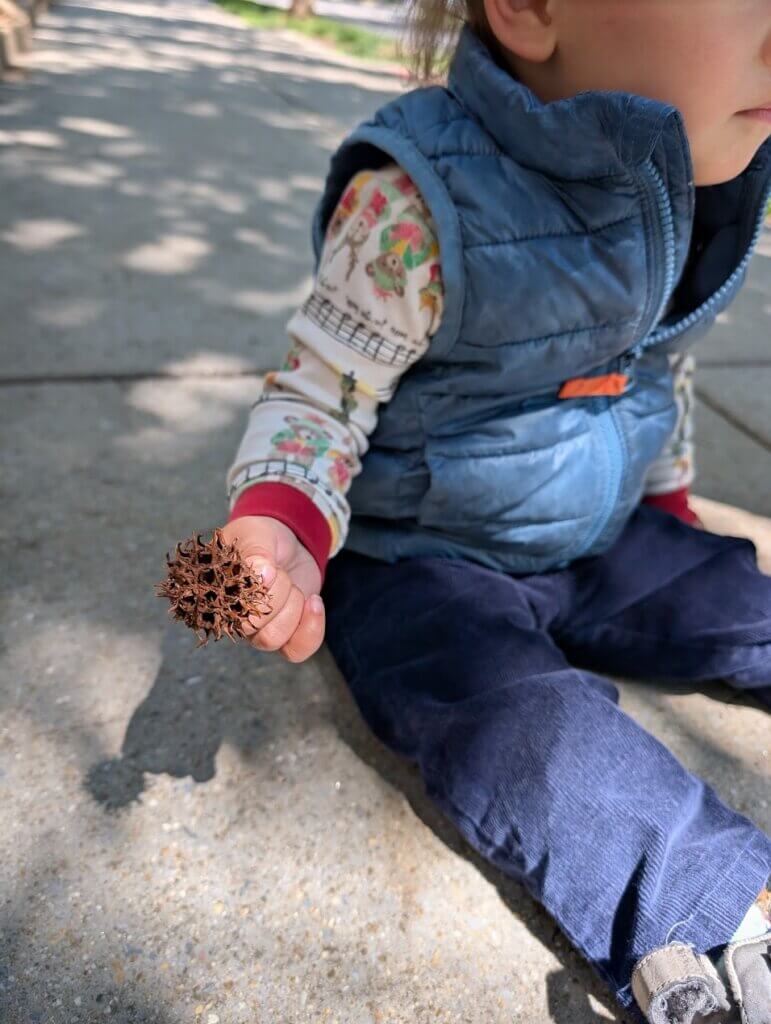
I want to tell you about lù lù tōng, because I find it both fascinating and beautiful. It is the dried fruit of a sweetgum tree—about the size of a large marble, spiky, and covered all over in tiny interconnected pores. In Chinese medicine, its very appearance suggests its purpose: everything flows through, everything is connected. Its name means exactly that—”all roads flow freely.”
It is used to open the twelve meridians, including the channels involved in milk production. Its nature is mild, and it has almost no flavor, so it can be simmered directly in soup or boiled as a tea without any unpleasant taste. It is especially helpful in those early days of breastfeeding, when milk is coming in but not yet flowing freely.
Research note: A 2024 article published in Frontiers in Nutrition entitled Advancing breastfeeding promotion: leveraging integrative natural galactagogues and unveiling their potential roles describes lù lù tōng as promoting blood circulation, unblocking channels, relieving pain, and alleviating joint stiffness.
Wáng Bù Liú Xíng (王不留行): For Lactation Support
This herb’s name is almost playful in Chinese: it means “even a king cannot make it stay.” Nothing can stop its flow. It is used similarly to lù lù tōng—to encourage the smooth movement of milk through the breast tissue.
When my daughter had her first baby, I consulted a well-known Chinese medicine practitioner in California, Dr. Zhang Ji, before the birth. He recommended both lù lù tōng and wáng bù liú xíng. I cooked both together in her soup. She went on to breastfeed that baby for two and a half years.
By the time her second baby arrived, there was no need to use them again. The channels were already open. The source had water; the pipes were clear. But that first time, opening those pathways well, mattered enormously.
A note from the research: The journal article Advancing breastfeeding promotion: leveraging integrative natural galactagogues and unveiling their potential roles describes a combination of lù lù tōng and wang bu liu xing as ideal for supporting lactation. The authors state, “Wang Bu Liu Xing is traditionally used for promoting lactation and treating breast abscess, while Lu Lu Tong has been linked with improving circulation and reducing swelling.”
Chinese Yam (山药): Where Food and Postpartum Herbs Meet
We say in Chinese medicine: yào shí tóng yuán—medicine and food share the same origin. Chinese yam is perhaps my favorite example of this idea in practice.
It is a food you can eat every day, especially in the first week postpartum when the body needs nourishment that is gentle and easy to digest. A simple yam and red date congee, or steamed yam, is ideal in those early days. After the first week, as the body begins recovering its strength, yam can go into heartier preparations—simmered with pork ribs in a nourishing broth, for example.
Chinese yam supports digestion, helps the body absorb nutrients, and in Chinese medicine is said to tonify the spleen and stomach—organs considered central to postpartum recovery. For a breastfeeding mother, it is also thought to support the production of milk and replenish qi and blood. As a food, the quantity doesn’t need to be precise. Let the new mother’s appetite and preference guide you.
A note from the research: Studies have found that Chinese yam (Dioscorea opposita) contains prebiotic fiber that supports the gut microbiome, as well as compounds with anti-inflammatory properties. Postpartum gut health affects everything from nutrient absorption to mood, making this quiet, unassuming vegetable a meaningful choice (Cui et al., 2023).
The Everyday Postpartum Pantry
Beyond the herbs above, there are four ingredients I consider essential to any postpartum kitchen: Astragalus (黄芪 — Huáng Qí), Red Dates (红枣 — Hóng Zǎo), Goji Berries (枸杞 — Gǒu Qǐ), and Ginger (生姜 — Shēng Jiāng).
They are used throughout Chinese cooking in everyday soups and teas, and their benefits accumulate gently over time. A simple formula that brings all of these together: when making pork rib or chicken broth, add 10g astragalus, 3 red dates, and a thumb-sized piece of ginger. Add goji berries in the last five minutes. The result is a broth that is deeply nourishing and genuinely delicious.
A full guide to sourcing and using these ingredients can be found here, and you can see them in action in my recipes for longan date tea and herbal chicken soup.
Closing Thoughts
I began this series by saying: you don’t have to believe everything. But do not dismiss everything either. At the very least, try one thing at a time and observe your own experience.
These herbs and rituals have accompanied women through one of the most profound transitions of human life for a very long time. They are not magic. They work slowly and gently, which, in my view, is also why they tend to be safe. Most herbs do not act immediately, and perhaps that patience is part of what makes them trustworthy. The body is not in a hurry to recover. Why should we be?
To be close to nature, to accept what nature offers, to explore the wisdom behind yào shí tóng yuán—food and medicine from the same source—and to care for yourself at each stage of life: for me, this is a lifelong practice worth pursuing.
Read Part 1 of this series for the dandelion herbal foot bath — a warm, simple ritual you can do right now with herbs from your own backyard.
What do you think? Let us know in the comments!
This post is for informational purposes only and does not constitute medical advice. Always consult your healthcare provider before beginning any herbal regimen, especially while breastfeeding.
References
Cui, Y., Zhou, Y., Li, Y., Wang, J., Li, D., & Chen, F. (2023). Chinese yam and its active components regulate the structure of gut microbiota and indole-like metabolites in anaerobic fermentation in vitro. Nutrients, 15(24), Article 5112. https://doi.org/10.3390/nu15245112
Liao, C. C., Chien, C. H., Hsu, T. J., & Li, J. M. (2024). Advancing breastfeeding promotion: Leveraging integrative natural galactagogues and unveiling their potential roles—Insights from a 19-year Taiwan nationwide registry to address lactation insufficiency in postpartum women. Frontiers in Nutrition, 11, Article 1293735. https://doi.org/10.3389/fnut.2024.1293735
Zhang, R. H., Liu, Z. K., Yang, D. S., Zhang, X. J., Sun, H. D., & Xiao, W. L. (2018). Phytochemistry and pharmacology of the genus Leonurus: The herb to benefit the mothers and more. Phytochemistry, 147, 167–183. https://doi.org/10.1016/j.phytochem.2017.12.016




2 Comments